

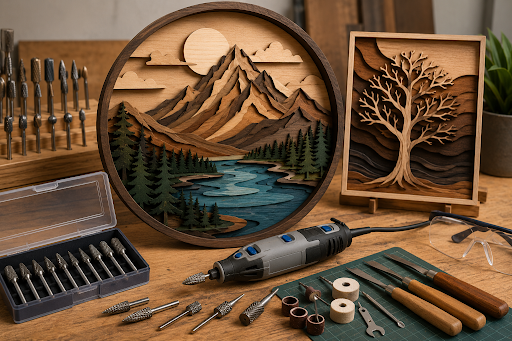
Few woodworking styles create as much visual impact as a technique built from multiple cut and shaped wood pieces stacked to produce real depth and dimension. Layered wood art combines precision saw cutting with the sculpting capability of powered carving tools, opening up a genuinely expansive creative range — from detailed topographic wall art to sculptural relief pieces that transform raw wood into something with real visual depth.
What Defines Layered Wood Art
At its core, layered wood art is built from multiple pieces of wood — often cut in graduated shapes or contours — stacked and secured to create a three-dimensional composition. Each layer contributes to the overall depth and shape of the finished piece, whether the design mimics natural topography, an abstract geometric composition, or a more literal sculptural subject like an animal or landscape scene. A fine-bladed saw is typically the tool of choice for cutting the individual layers with the precision that clean, well-fitted joins require.
Once the layers are cut and assembled, the real transformation happens in the shaping and finishing stage. This is where powered carving tools come into play — smoothing transitions between layers, adding surface texture, carving fine detail into edges, and blending the stepped layers into flowing, organic contours that elevate the piece from a stack of flat cuts into a genuinely sculptural object.
Scroll Saw Precision as the Foundation
The quality of any layered wood art project begins with the accuracy of the scroll saw cutting. A scroll saw’s fine blade and slow, controlled cutting action make it uniquely suited to producing the intricate, curved, and detailed shapes that layered compositions require — shapes that would be difficult or impossible to achieve cleanly with a bandsaw or jigsaw. Pattern-based cutting, where a design is transferred to the wood and cut layer by layer, is the standard workflow for artists building complex layered compositions.
- Blade selection: Fine-toothed blades produce the clean, splinter-free edges that layered art requires for good glue joints
- Pattern transfer: Printed or traced patterns applied directly to each wood layer guide accurate cutting
- Wood selection: Contrasting wood species and grain patterns add visual interest between adjacent layers
- Layer thickness: Consistent stock thickness across all layers ensures even, predictable stacking and alignment
- Test cuts: Practicing on scrap material before cutting final layers protects against costly mistakes in finished stock
Where the Art Comes Alive
Once the layers are cut and glued, powered carving accessories are what transform a stacked composition into a finished piece of art. Carving burrs and bits remove material quickly and precisely, allowing artists to blend the visible steps between layers into smooth, flowing contours, or to intentionally leave stepped terracing for a more graphic, topographic look depending on the desired final effect.
The versatility of a rotary carving tool is what makes it indispensable at this stage. A single tool, fitted with different burr shapes and grits, can carve broad material quickly with an aggressive carbide burr, refine detail with a finer stone or diamond bit, and finish surfaces with a sanding drum — covering the full range of shaping tasks a layered wood art project demands without switching between multiple separate tools.
Choosing the Right Burrs for Layered Work
Selecting the correct carving accessories for layered wood art depends on the stage of the project. Coarse, aggressive burrs remove bulk material quickly when blending steep transitions between thick layers. Medium burrs refine the shape and begin smoothing the transitions into more organic contours. Fine burrs and detail bits add texture, carve fine lines, and create the small sculptural details — wood grain effects, bark texture, or fine linework — that elevate a piece from good to exceptional.
Carbide-toothed burrs are particularly well suited to this kind of layered carving because they cut aggressively without loading up with debris, maintaining consistent performance across extended carving sessions and keeping creative momentum going during long projects.
Final Words
This layered technique rewards the combination of precise saw cutting and skilled sculptural finishing in equal measure. Explore Kutzall’s range of wood carving tools rotary and scroll saw accessories to bring your next project to life with the precision and durability serious woodworkers demand.
 Sally
Sally