

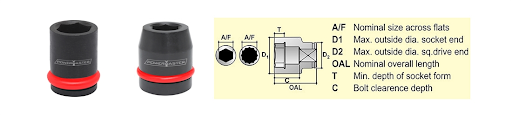
Fastener rounding remains one of the most common and preventable failures in industrial and automotive maintenance work. A large part of that failure traces back to socket geometry rather than the fastener itself. Anyone buying tools for repeated high-torque work should look closely at how a square impact socket grips a bolt head before placing an order.
Understanding the Conventional Corner Problem
Standard socket profiles make contact with a fastener right at its corners. Under impact loading, this creates concentrated stress at a few small points instead of spreading the load across the surface. Over time, those corner contact points wear down, round off, and eventually strip the fastener entirely. Technicians working with old, rusted, or already worn bolts feel this problem most, since a slightly rounded head combined with a corner-contact socket often means the fastener cannot be removed without cutting or drilling.
What are the Freecorner Profile Changes
The Freecorner profile shifts contact away from the fastener’s corners and distributes the load across the flat surfaces instead. This single design change addresses several problems at once:
- Reduces the risk of rounding off fastener heads during removal or installation.
- Improves the odds of successfully turning fasteners that are already worn.
- Removes high-stress concentration points, which increase both impact resistance and torque-transmitting capability.
Sockets built with this profile apply the geometry to both the square drive end and the hexagon opening, so the benefit extends throughout the entire tool, not just to one contact surface. This matters for 1/2-inch square-drive sockets and larger sizes, where flats above 5/8 inch are used most in industrial settings.
Material and Build Considerations
Profile geometry only performs as intended when paired with the right base material and finishing process. Sockets meant for repeated impact work should be made from high-strength alloy steel and heat-treated to balance strength with impact resistance. Chamfered openings help the socket engage smoothly with both the drive tool and the fastener, while concentric openings and adequately sized clearance holes keep the socket within industrial specifications. A Ring-N-Pin arrangement for securing the socket to the drive, along with plating or black oxide coating for rust protection, rounds out what a properly built socket needs.
Sourcing From the Right Supplier
Buyers working with spline-drive systems face the same corner-contact issue, which makes the choice of spline impact socket distributor just as important as the socket design itself. A reliable distributor should be able to confirm the profile geometry, base material, and heat treatment process for every socket in a batch order, not just the dimensions. For teams sourcing sockets in bulk for fleet maintenance, construction equipment, or turbine work, this level of transparency prevents costly downtime later.
Conclusion
Freecorner sockets save critical maintenance time compared to conventional designs. Before placing bulk orders, buyers should verify corner profiles, drive-end geometry, and heat-treatment records directly with suppliers rather than relying solely on size charts. Ultimately, a square impact socket built on sound geometry, paired with a distributor who stands behind specifications, saves time and money over the lifecycle, making these factors, rather than price alone, the true guide for sourcing decisions.
 David Martinez