

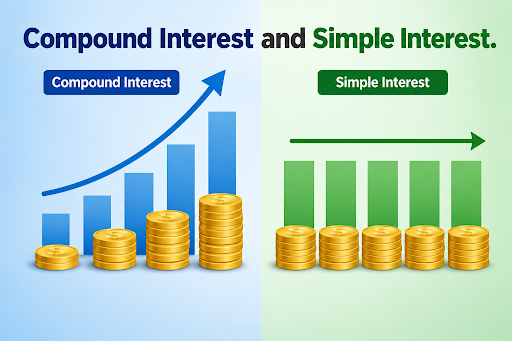
In the world of finance, understanding how interest works is paramount. Whether you’re saving for a goal, applying for a loan, or investing in the stock market, knowing the difference between compound interest and simple interest can make a significant difference in your financial planning. This article delves into the formulas for both types of interest, illustrating their differences with solved examples.
What Is Simple Interest?
Definition
Simple interest is calculated on the principal amount or the initial sum of money that is deposited or borrowed. The compound interest and simple interest formula can be understood by first learning how simple interest is calculated. The formula for simple interest can be expressed as:
Simple Interest (SI) = Principal (P) × Rate (R) × Time (T)
Where:
- SI = Simple Interest
- P = Principal amount (initial investment or loan)
- R = Rate of interest per annum (as a decimal)
- T = Time period in years
Example of Simple Interest Calculation
Let’s say you invest $1,000 at an annual interest rate of 5% for 3 years. To calculate the simple interest, we can use the formula:
- Identify the components:
- P = $1,000
- R = 0.05 (5% expressed as a decimal)
- T = 3 years
- Plug these values into the formula:
SI = P × R × T
SI = $1,000 × 0.05 × 3
SI = $150
Therefore, the simple interest earned on this investment will be $150 after 3 years.
What Is Compound Interest?
Definition
Compound interest, as opposed to simple interest, is calculated on the principal amount and also on the interest that accumulates from prior periods. This means that the interest earned each period is added to the principal for the next period. The formula for compound interest can be expressed as:
Compound Interest (CI) = Principal (P) × (1 + Rate (R)/n)^(n × Time (T)) – Principal (P)
Where:
- CI = Compound Interest
- P = Principal amount (initial investment or loan)
- R = Annual interest rate (as a decimal)
- n = Number of times interest is compounded per year
- T = Time in years
Example of Compound Interest Calculation
Assuming you invest the same $1,000 at an annual interest rate of 5%, but this time compounded annually for 3 years, the calculation would look like this:
- Identify the components:
- P = $1,000
- R = 0.05
- n = 1 (since it is compounded annually)
- T = 3 years
- Plug these values into the formula:
CI = $1,000 × (1 + 0.05/1)^(1 × 3) – $1,000
CI = $1,000 × (1 + 0.05)^3 – $1,000
CI = $1,000 × (1.157625) – $1,000
CI = $1,157.63 – $1,000
CI = $157.63
So, the compound interest earned would be approximately $157.63 after 3 years.
Key Differences Between Simple Interest and Compound Interest
Calculation
- Simple Interest is straightforward as it only considers the principal amount.
- Compound Interest takes into account the accumulated interest, leading to a more complex calculation.
Earnings Over Time
- With Simple Interest, the interest earned remains constant over time, specifically linked to the principal.
- Compound Interest grows exponentially since it adds accumulated interest back to the principal.
Final Amount
To illustrate the difference in total amount earned, let’s consider the total amount with both methods after 3 years:
- For Simple Interest:
Total Amount = Principal + Simple Interest
Total = $1,000 + $150 = $1,150 - For Compound Interest:
Total Amount = Principal + Compound Interest
Total = $1,000 + $157.63 = $1,157.63
When to Use Each Formula
Simple Interest
Simple interest is generally used when dealing with short-term loans or investments where the calculation is straightforward and uncomplicated. It is also commonly applied in situations such as car loans, personal loans, or bonds.
Compound Interest
Compound interest is relevant in long-term investments and savings vehicles like savings accounts, retirement accounts, and stocks. The longer the investment duration, the more significant the effect of compounding will be, which can lead to substantial growth over time.
Frequently Asked Questions
What is the formula for interest?
Understanding what is the formula for interest? depends on whether the interest is calculated using the simple interest or compound interest method. The formula for calculating interest differs based on the type:
- For Simple Interest: SI = P × R × T
- For Compound Interest: CI = P × (1 + R/n)^(n × T) – P
Conclusion
In finance, understanding the compound interest and simple interest formula is essential for making informed decisions regarding investments, loans, and savings. While simple interest provides clarity for short-term loans or deposits, compound interest maximizes earnings over a longer term due to its ability to leverage interest on interest. By applying these formulas effectively, you can enhance your financial literacy and make more strategic decisions regarding your money. Always take the time to calculate both types of interest when considering your financial options, as the difference can lead to significantly varied outcomes over time.