

Imagine this: You have a revolutionary app idea that could transform your business. The possibilities are exciting, but there’s a problem, you don’t know the first thing about coding. Hiring a professional developer feels expensive and time-consuming, and the thought of learning complex programming languages seems impossible.
This is where the best drag and drop app builder free tools come into play. These platforms are redefining the way entrepreneurs, small businesses, and even large enterprises develop applications. With intuitive interfaces, pre-built templates, and visual workflows, anyone can create functional, professional-quality apps without writing a single line of code. In this article, we’ll explore how drag and drop app builders are simplifying app development and empowering non-technical users to become creators.
The Challenges of Traditional App Development
Traditional app development can feel like learning an entirely new language. It requires proficiency in coding languages, frameworks, and development tools, a skill set that takes years to master. Even if you hire a development team, the process is costly and slow. The average simple app can cost between $25,000 and $50,000, while more complex applications can run into hundreds of thousands of dollars.
Other hurdles include:
- Time and Scalability: Building and maintaining apps takes months, and scaling them as your business grows requires ongoing updates and developer resources.
- Security Risks: Each line of code is a potential vulnerability. Ensuring your app is secure requires constant monitoring and expert knowledge.
- Resource Dependence: Recruiting reliable developers is difficult. In fact, over 80% of businesses report challenges in hiring and retaining qualified software engineers.
Understanding Drag and Drop App Builders
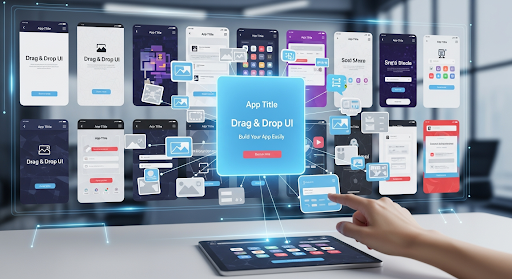
So, what makes drag and drop app builders so transformative? At their core, these platforms allow users to create applications visually. Instead of coding, you “drag” elements like buttons, forms, or media files from a menu and “drop” them into your app interface.
Here’s how the process typically works:
- Choose a Template: Most platforms offer pre-designed templates, giving you a framework to start your app quickly.
- Customize Features: Add and arrange features like forms, payment modules, and media components using the drag-and-drop interface. Integration with third-party tools is also possible.
- Test Your App: Preview your app in real time to ensure it functions correctly.
- Publish and Collaborate: Once ready, you can launch the app, assign user roles, and integrate it with your business systems.
Why Drag and Drop App Builders Are Game-Changers
Drag and drop app builders offer several key advantages over traditional development:
1. Cost-Effective
Developing an app through conventional methods can be prohibitively expensive. Drag and drop builders reduce costs dramatically. Subscriptions often start at just $30 per month per user, making app creation accessible to startups and small businesses.
2. Time-Saving
With traditional coding, building even a simple app can take months. Drag and drop platforms allow you to design, test, and launch applications in days or weeks, accelerating your business’s ability to serve customers and innovate.
3. Flexible and Customizable
These tools offer extensive templates and features that allow you to tweak your app’s appearance and functionality easily. Adding new features or adjusting workflows takes just a few clicks.
4. Empowering Non-Developers
Anyone on your team, regardless of technical skill, can participate in app creation. This democratizes app development, fosters innovation, and reduces dependence on specialized developers.
5. Scalable and Integrative
Modern drag and drop platforms are built to integrate with existing business systems like CRM software, payment gateways, and cloud storage. They also allow your apps to grow with your business without requiring major redevelopment.
How to Choose the Right Drag and Drop App Builder
Not all platforms are created equal. To select the right tool, consider these factors:
- Ease of Use & UI/UX: Look for an intuitive interface that allows efficient workflow creation with minimal learning curve.
- Customization & Flexibility: Ensure the platform offers both pre-built templates and the ability to design apps from scratch.
- Integration Capabilities: Confirm compatibility with your existing software, APIs, and third-party tools.
- Scalability & Performance: Choose a cloud-based solution that supports growth and high traffic.
- Security & Compliance: Make sure the platform complies with regulations such as GDPR, HIPAA, and uses secure authentication.
- AI & Automation Features: Advanced platforms offer AI-driven analytics, predictive workflows, and automated testing.
- Support & Pricing: Verify the platform provides dedicated support and transparent, flexible pricing options.
Top Features of Drag and Drop App Builders
Modern drag and drop app builders often include:
- Intuitive Drag-and-Drop Interface: Build apps visually without coding.
- Pre-Built Templates & Components: Jumpstart your app development using reusable design elements.
- AI-Driven Automation & Workflows: Automate business logic and processes with AI assistance.
- Multi-Platform Deployment: Launch your app on web, iOS, Android, and cloud environments seamlessly.
- Advanced Security & Compliance: Ensure enterprise-grade protection for sensitive data.
Step-by-Step: Creating a Custom App
Here’s a simplified workflow to create your own app using a drag-and-drop platform:
- Set Goals: Identify your app’s features and business objectives.
- Pick a Template: Use pre-designed templates to save time and ensure a professional look.
- Add Content & Media: Incorporate graphics, videos, and text to engage users.
- Customize the UI: Adjust colors, fonts, and navigation to reflect your brand.
- Set the App Icon: Choose an icon that is recognizable and visually appealing.
- Preview & Test: Test the app for functionality and user experience.
- Publish & Launch: Deploy your app and share it with users.
Advantages of Drag and Drop App Builders
Here’s a quick summary of why these tools are so powerful:
- No Need for a Development Team: Build apps independently without relying on external developers.
- Fast Development Cycles: Launch apps in days, not months.
- Lower Costs: Avoid high development and maintenance expenses.
- Accessible to Non-Technical Users: Empower team members across roles to create applications.
- Flexible and Scalable: Easily adjust features and scale your app as your business grows.
- Integration-Friendly: Connect with CRMs, payment systems, cloud services, and APIs.
- AI-Enhanced: Automate workflows and gain predictive insights for smarter app performance.
Conclusion
Drag and drop app builders have revolutionized app development by eliminating the need for coding expertise, expensive development teams, and long timelines. They offer cost-effective, scalable, and user-friendly solutions, empowering entrepreneurs and businesses to turn ideas into fully functional apps. With intuitive interfaces, pre-built templates, and AI-powered tools, these platforms are making app creation faster, easier, and more accessible than ever.
For businesses seeking the best drag and drop app builders, Workmaster is an excellent choice. It enables users to build apps in minutes with drag-and-drop components, pre-built templates, AI-powered automation, and secure data access. Its flexible platform scales with your business, integrating seamlessly with third-party tools while providing advanced dashboards and analytics. Whether you’re launching a new project or streamlining operations, Workmaster makes app development simple, intuitive, and accessible for everyone.
 Kathie