

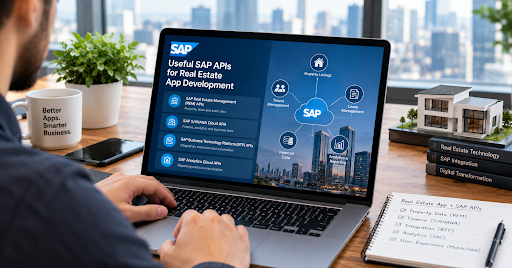
A property management firm spends three days every month manually extracting lease data from SAP, cleaning it up in spreadsheets, and importing it into the customer-facing portal their tenants use. The portal and SAP have been running simultaneously for two years. Nobody ever connected them. The data is all there in SAP, accurate and well-maintained but accessing it in a way the app can actually use requires a human in the middle doing work that software should be doing instead. This is a surprisingly common situation, and it’s exactly why development teams at any serious real estate app development company working with SAP-heavy clients spend significant time identifying which APIs actually solve this kind of problem versus which ones add complexity without enough payoff to justify it.
SAP is an enterprise platform that touches almost every corner of a large real estate operation financial accounting, asset management, leasing, procurement, facilities maintenance, analytics, and more. The APIs that expose this data to external applications have expanded significantly in recent years, particularly since SAP’s push toward cloud architecture and the BTP (Business Technology Platform) ecosystem. For a real estate app developer, the question isn’t whether SAP has useful APIs it definitely does the question is which ones matter for specific use cases and what the integration actually looks like in practice.
Understanding SAP’s API Landscape Before Diving Into Specifics
SAP offers APIs across several layers of its architecture, and understanding this before picking specific endpoints saves a lot of confusion later.
The older BAPI (Business Application Programming Interface) approach uses RFC (Remote Function Calls) and is still widely used in on-premise SAP ECC environments. Many real estate firms running legacy SAP installations will still have their core data accessible primarily through BAPIs. They work, but they’re not particularly modern or developer-friendly by current standards.
OData APIs sit on top of SAP’s more modern architecture, particularly S/4HANA and SAP Fiori. They follow RESTful conventions and return JSON or XML, which makes them considerably easier to work with from a mobile or web app development perspective. If a client is running S/4HANA Cloud or a hybrid environment, OData is usually the path of least resistance.
SAP BTP (Business Technology Platform) is the broader integration layer that SAP has been pushing hard, and it includes the Integration Suite, API Management tools, and pre-built connectors that can mediate between SAP and external applications. For complex real estate app integrations, BTP often ends up being the glue layer rather than connecting directly to SAP’s core APIs.
SAP RE-FX: The Core of Real Estate Functionality
SAP RE-FX (Flexible Real Estate Management) is the module where most of the relevant real estate data actually lives lease contracts, property master data, condition types, measurement values, usage types, and business partner assignments. For any app that needs to display or manipulate lease terms, property attributes, or rental conditions, RE-FX is where the integration work is centered.
The APIs exposing RE-FX data vary depending on whether the environment is ECC or S/4HANA. In S/4HANA, SAP has been progressively releasing OData services for RE-FX objects, including:
Lease contract APIs expose the core structure of a lease parties, objects, start and end dates, notice periods, renewal conditions, and financial conditions. These are essential for any tenant-facing app that needs to show lease details, upcoming renewals, or contractual terms without requiring users to log into SAP directly.
Real estate object APIs cover the property master data buildings, floors, rental units, land parcels including their hierarchical relationships. Any app that displays a property portfolio or lets users navigate from a building down to individual units relies on these object structures.
Condition APIs handle the financial terms within a lease base rent, service charges, index escalations, turnover rent, and other condition types. Apps that need to display rent breakdowns or generate payment summaries pull from these endpoints.
SAP Finance and Accounting APIs
Real estate operations generate significant financial data, and most real estate apps at the enterprise level need some window into financial performance, even if users don’t interact with the full accounting detail.
FI-AR (Accounts Receivable) APIs expose rent posting data, outstanding receivables, payment histories, and dunning statuses. For a tenant portal, these APIs drive the payment history view and any outstanding balance display. For a property management dashboard, they feed the receivables aging report.
FI-GL (General Ledger) APIs expose the underlying accounting entries and are more relevant for internal management apps than tenant-facing ones. Portfolio analysis tools and executive dashboards often pull from GL data to give a clean profitability view by property or cost center.
SAP S/4HANA Cloud for Finance has published a growing library of OData services covering journal entries, account balances, and payment documents. The coverage is more complete for cloud deployments than for on-premise ECC installations, which sometimes require custom BAPI-based integration.
Plant Maintenance and Facilities Management APIs
Property management apps that handle maintenance requests are one of the most common real estate app use cases, and SAP’s Plant Maintenance (PM) module is where work orders, equipment master data, and maintenance notifications live.
Maintenance notification APIs allow external apps to create notifications in SAP when a tenant submits a maintenance request, without anyone manually entering data into SAP. This closes the loop between the tenant-facing app experience and the back-office maintenance management workflow.
Work order APIs expose the status and details of active work orders, which is what powers real-time maintenance tracking in a tenant or facilities manager portal. A tenant who submitted a maintenance request two days ago and wants to know whether anyone has actually looked at it is querying work order status, whether they know that’s what’s happening or not.
Equipment and functional location APIs provide the asset master data for properties and equipment, which matters for apps that track preventive maintenance schedules or need to display asset history for a specific unit.
SAP Customer Experience (CX) and Business Partner APIs
Real estate businesses deal with a wide range of counterparties tenants, landlords, brokers, vendors, contractors. The Business Partner (BP) model in SAP S/4HANA consolidates these previously fragmented master records, and the APIs that expose BP data are foundational for any app that needs to know who a party is and what role they play.
Business Partner OData APIs cover the creation, modification, and retrieval of partner records including addresses, communication data, relationship types, and role assignments. Any app that needs to display tenant contact details, manage landlord information, or look up a contractor in the context of a work order is pulling from BP data.
SAP CRM / C4C APIs come into play when the real estate firm also manages prospect and lead data separately from active tenants. Leasing apps and prospecting tools that need to push leads captured through the app back into a CRM layer often connect to these APIs rather than directly to RE-FX.
Document Management and Output APIs
Real estate transactions generate a lot of documents lease agreements, addenda, invoices, correspondence, inspection reports. SAP’s Document Management System (DMS) and its output management capabilities expose APIs that real estate apps can use to retrieve, generate, and store documents in a structured way.
DMS APIs allow apps to retrieve documents associated with specific real estate objects or contracts, which powers document centers in tenant portals where residents can access their lease agreement or review past invoices.
Output management APIs in S/4HANA handle the generation of formatted output from SAP forms, which is useful when an app needs to trigger document generation rather than just retrieval a rent statement generated on demand, for instance, rather than pulled from a stored copy.
Analytics and Reporting APIs
SAP Analytics Cloud (SAC) and Embedded Analytics in S/4HANA expose data through OData and custom APIs that real estate apps can use to display key performance indicators without building a separate reporting layer.
Portfolio performance APIs expose occupancy rates, vacancy trends, rent roll data, and lease expiration profiles exactly the kind of summary data that goes into an executive dashboard or investor-facing app. Rather than calculating these from raw data in the app layer, connecting to SAP’s analytics layer means these figures are already calculated using the same logic the finance team uses, which avoids discrepancies between what the app shows and what finance reports.
SAP BW/4HANA APIs expose data warehouse content for organizations that have built their analytics layer on SAP BW. These are particularly relevant for larger portfolio operators who run complex reporting across thousands of properties with multiple legal entities.
Practical Integration Considerations
Understanding which APIs exist is only the starting point. The practical integration work involves several additional layers that affect both the quality of the outcome and the app development timeline significantly. Authentication and authorization through SAP OAuth or API Management need to be configured before any data flows. The sandbox environment whether SAP provides a public sandbox or the client needs to set up a dedicated test environment affects how quickly development can begin in earnest. Data volume and pagination behavior in OData APIs need to be tested against realistic data sets, because behavior that looks fine against a small test set sometimes breaks under production volumes. And the delta/change data patterns matter for apps that need to stay in sync with SAP rather than pulling full datasets on every load.
All of these factors compound when the SAP environment is heavily customized, which is common in enterprise real estate firms that have been running SAP for a decade or more. Custom fields, custom condition types, and extended business partner roles often require custom API extensions rather than relying purely on standard SAP-delivered endpoints.
What This Means for Development Teams
For development teams approaching a real estate app integration with SAP for the first time, the most important early step is a proper API discovery phase understanding exactly which SAP version and modules the client runs, what standard API coverage exists, and where custom development will be needed to expose data that standard APIs don’t cover.
This discovery phase isn’t glamorous, but it consistently has the biggest impact on how smoothly the integration project runs. Teams that skip it tend to discover mid-project that a critical piece of data lives in a custom table that has no standard API, which requires either a scope change, a workaround, or building a custom BTP extension all of which are considerably more disruptive when discovered halfway through than when identified at the start.
Final Thoughts
SAP’s API landscape for real estate has matured considerably, particularly for organizations running S/4HANA, and the combination of RE-FX, finance, plant maintenance, business partner, and analytics APIs covers the vast majority of real estate app use cases without requiring purely custom development. The integration is never entirely plug-and-play SAP environments are complex and heavily customized in most enterprise deployments but the standard APIs provide a solid foundation that experienced teams can build on reliably. The organizations that get the most out of SAP-integrated real estate apps are the ones that invest properly in the discovery and architecture phase before rushing into development, because the technical decisions made at the start shape the quality and maintainability of the integration for years afterward.