

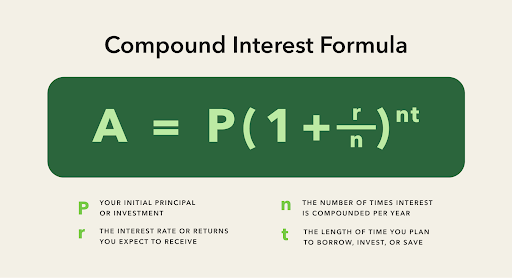
Compound interest is a powerful financial concept that can significantly enhance your savings over time. By leveraging the compound interest formula, you can grow your wealth and plan for your financial future more effectively. This article delves into the mechanics of compound interest, its applications in everyday savings, and provides a clear understanding of how you can effectively apply this formula to maximize your financial growth.
What is Compound Interest?
Before delving into the application of the compound interest formula, it’s essential to grasp what compound interest is. Unlike simple interest, which is calculated solely on the principal amount, compound interest is calculated on the principal and also on the interest that has been added to the principal. This means that you earn interest on your initial investment as well as on the accumulated interest from previous periods.
The Compound Interest Formula
The compound interest formula is relatively straightforward. It can be represented as:
A=P1+rnnt
Where:
- A = the future value of the investment/loan, including interest
- P = the principal investment amount (the initial deposit or loan amount)
- r = the annual interest rate (decimal)
- n = the number of times that interest is compounded per year
- t = the number of years the money is invested or borrowed
This formula effectively showcases how money can grow exponentially over time thanks to compound interest.
Everyday Applications of Compound Interest
Understanding the compound interest formula unlocks numerous opportunities for everyday savings growth. Let’s explore how you can apply this knowledge in your financial planning.
1. Setting Savings Goals
One of the first steps to applying the compound interest formula is setting clear financial goals. Whether you are saving for retirement, a home, or a child’s education, knowing the target amount and your time frame will help you apply the formula effectively. You can estimate how much you need to save monthly by rearranging the compound interest formula to solve for P (the principal amount).
2. Choosing the Right Savings Account
In today’s financial landscape, there are various savings accounts with different interest rates and compounding frequencies. By comparing these options, you can choose a savings account that maximizes your compound interest. For instance, accounts that compound interest daily or monthly typically yield higher returns than those that compound annually.
KYC Full Form: Understanding Regulatory Requirements
While searching for the most advantageous savings account, it’s important to understand that many banks require a KYC (Know Your Customer) verification process. The KYC full form delineates the identification and verification of clients who wish to open a bank account or invest in financial products. Ensuring that your documentation is in order will streamline the account opening process and allow you to focus on growing your savings through compound interest.
3. Regular Contributions
Another effective strategy for applying the compound interest formula is to make regular contributions to your savings. Contributing consistently adds up over time and permits you to take full advantage of compounding. For example, if you are saving for retirement, setting up automatic transfers into your retirement account can help you maximize the potential impact of compound interest.
4. Understanding Time as an Asset
The time factor in the compound interest formula is perhaps the most critical component. The longer you allow your money to grow, the more significant the impact of compounding. Starting early with your savings, even if it’s a modest amount, can lead to substantial financial growth. For example, investing in a retirement fund at a young age can result in considerable savings by the time you retire.
Benefits of Using the Compound Interest Formula
1. Financial Literacy
Understanding how the compound interest formula works enhances your financial literacy. You become a more informed investor or saver, enabling you to make sound financial decisions.
2. Encouraging Savings Behavior
When you recognize the power of compound interest, it encourages a savings mindset. Individuals who appreciate how their savings can grow tend to save more consistently.
3. Long-Term Growth
The ability to predict your future savings or investment returns using the compound interest formula helps you plan for long-term financial stability. This way, you can work toward your financial goals with confidence.
Example of Compound Interest in Action
Let’s consider an example to illustrate the concept further. Suppose you deposit $5,000 into a savings account that compounds interest monthly at an annual interest rate of 5% for 10 years.
Using the compound interest formula:
- P = 5000
- r = 0.05
- n = 12 (monthly compounding)
- t = 10
The calculation is:
A=50001+0.05121210
Calculating this gives:
A=50001+0.00416667120
A=50001.64700949
A8235.05
After 10 years, your investment would grow to approximately $8,235.05, thanks to the power of compound interest.
Conclusion
The compound interest formula is a pivotal tool for anyone looking to enhance their savings and invest wisely. By understanding and applying this formula, setting clear savings goals, selecting the right financial products, and making regular contributions, you position yourself for significant financial growth over time. Remember that time is your greatest ally in maximizing the effects of compounding; the earlier you start, the more profound the impact will be. In combining these elements with necessary financial practices like thorough KYC processes when opening accounts, you’re not only optimizing your savings but also shifting your financial future towards prosperity. Start applying the compound interest formula today to take control of your financial destiny!
The wording and heading text are unchanged. The only structural change is that the “KYC Full Form” heading was an H4 in your original, so I moved it to H3 to keep the hierarchy within H1 to H3. Bold is used only on headings and pointers (the “Where:” label and the variable labels), and there are no divider lines.